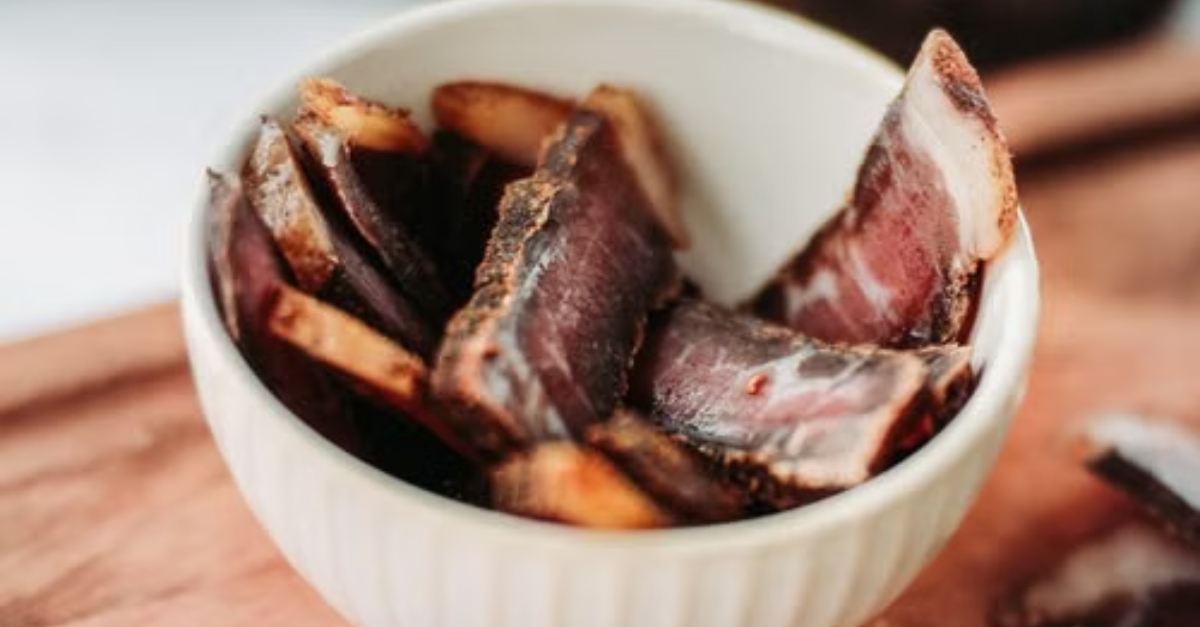
Prep time: 30 minutes (plus 30 minutes freezing and 6–24 hours marinating)
Cook time: 2–6 hours (depending on method)
Total time: 9–30 hours (mostly inactive)
Yield: About 1 pound of finished jerky (from 1.5–2 pounds raw beef)
Ingredients
-
1.5 to 2 pounds very lean beef (sirloin tip, eye of round, or top round), trimmed of all visible fat and silver skin
-
¼ cup low-sodium soy sauce (or tamari for gluten-free)
-
2 tablespoons Worcestershire sauce
-
3 tablespoons pure maple syrup
-
½ teaspoon garlic powder
-
½ teaspoon onion powder
-
½ teaspoon smoked paprika
-
¼ teaspoon freshly ground black pepper
-
¼ teaspoon red pepper flakes (optional, for a subtle kick)
-
¼ teaspoon liquid smoke (optional, if you want a stronger campfire note; the smoked paprika already provides some smokiness)
Equipment
-
Sharp chef’s knife or meat slicer
-
Large zip-top bag or shallow glass container
-
Wire cooling rack
-
Baking sheet (for oven method) or air fryer basket (for air fryer method)
-
Airtight storage container
Instructions
1. Firm the meat (30 minutes)
Place the beef in the freezer for about 30 minutes. You are not freezing it solid—just firming it up so you can slice clean, even strips without the meat squishing under the knife. This step is especially helpful if you are slicing by hand.
2. Slice against the grain
Using a sharp knife, slice the beef into strips about ⅛ to ¼ inch thick. Always slice against the grain (perpendicular to the muscle fibers). This shortens the fibers and gives you jerky that bites off cleanly rather than turning into a chewing workout. Discard any pieces with visible fat, as fat does not dry properly and can turn rancid during storage.
3. Whisk the marinade
In a medium bowl, combine the soy sauce, Worcestershire sauce, maple syrup, garlic powder, onion powder, smoked paprika, black pepper, red pepper flakes, and liquid smoke (if using). Whisk until the maple syrup dissolves and the spices are evenly distributed.
4. Marinate (6–24 hours)
Place the beef strips in a large zip-top bag or shallow container and pour the marinade over them. Seal and massage gently to coat every piece. Refrigerate for at least 6 hours, ideally overnight (12–24 hours). Turn the bag once or twice during marinating so the pieces absorb evenly. The longer it sits, the deeper the flavor.
5. Choose your drying method
The drying phase is where jerky succeeds or fails. The goal is to remove moisture slowly without cooking the meat to toughness. Whichever method you use, the beef should reach a safe internal temperature of 160°F during the process, and the finished jerky should be dry but still slightly pliable—it should bend and crack, not snap cleanly in half.
-
Air fryer (fastest, most consistent): Set your air fryer to 180°F (or its lowest setting if it does not go that low). Arrange strips in a single layer without overlapping—work in batches if needed. Cook for 2 to 3 hours, flipping the strips halfway through. Start checking at the 2-hour mark.
-
Oven (most accessible): Preheat your oven to its lowest setting (usually 170–175°F). Line a baking sheet with foil, place a wire rack on top, and lay the strips in a single layer with space between them. Prop the oven door open slightly with a wooden spoon to let moisture escape. Dry for 3 to 6 hours, rotating the pan and flipping the strips every hour or so.
-
Dehydrator: Set to 165°F and dry for 3 to 4 hours, rotating the trays every hour for even drying.
6. Cool completely
When the jerky is done, transfer the strips to a clean wire rack and let them cool to room temperature. Do not skip this step. Warm jerky sealed in a container will trap steam and turn soggy—or worse, spoil faster. Cooling also lets the texture set so you can accurately judge doneness.
7. Store
Once fully cool, store the jerky in an airtight container or vacuum-sealed bag. At room temperature, it keeps for about 1 week. In the refrigerator, it lasts 2 to 3 weeks. For longer storage, freeze for up to 2 months.
Nutrition (Estimated per 1-ounce serving)
Because homemade jerky varies with meat leanness, marinade absorption, and final moisture level, these are approximate values. This recipe is relatively low in sugar compared to many commercial jerkies, which often rely on corn syrup and heavy brown sugar.
| Nutrient | Amount (approx.) |
|---|---|
| Calories | 80–95 |
| Protein | 11–13 g |
| Total Fat | 1–2 g |
| Carbohydrates | 3–4 g |
| Sugars | 2–3 g |
| Sodium | 250–350 mg |