| Prep Time | 45 minutes |
| Cook Time | 40 minutes (processing time varies by altitude) |
| Total Time | ~1 hour 30 minutes (plus cooling) |
| Yield | 7 quart jars (or 14 pint jars) |
| Difficulty | Intermediate |
| Cuisine | French / Meal Prep |
Why Make Your Own?
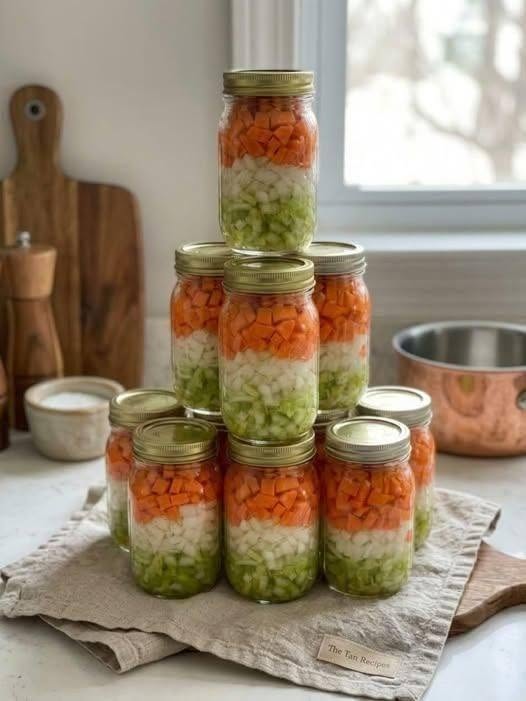
Mirepoix is the aromatic trio — onion, carrot, and celery — that starts countless soups, stews, braises, and sauces. Having it pre-chopped and shelf-stable means dinner prep drops to minutes. Home canning lets you control the ratios, skip preservatives, and use up garden surplus. Important: This is a pressure-canned recipe. Mirepoix is a low-acid mixture and must be processed in a pressure canner — a boiling water bath is not safe for this recipe.
Ingredients
Per quart jar (multiply as needed):
-
1 cup diced yellow onion (about 1 medium onion)
-
1 cup diced carrots (about 2 medium carrots)
-
1 cup diced celery (about 2 stalks)
For 7 quarts total:
-
7 cups diced yellow onion (about 7 medium onions)
-
7 cups diced carrots (about 14 medium carrots)
-
7 cups diced celery (about 14 stalks)
-
Canning salt (optional): ½ teaspoon per pint, 1 teaspoon per quart
-
Boiling water (optional, if hot-packing with liquid) — or can with no liquid added
-
Lemon juice (optional): 1 tablespoon per quart for brightness — not required for safety, but adds flavor
Do not add: oil, butter, garlic in oil, or thickeners — these are unsafe for home canning.
Equipment Needed
-
Pressure canner (dial-gauge or weighted-gauge) — essential
-
7 quart jars or 14 pint jars, lids, and bands (sterilized)
-
Jar lifter, funnel, bubble remover, lid wand
-
Large stainless steel pot (for blanching)
-
Sharp chef’s knife and cutting board
-
Clean kitchen towels
-
Timer
Instructions
Step 1: Prepare the Jars and Canner — Time: 10 minutes | Intensity: Low
Wash jars, lids, and bands in hot soapy water. Keep jars hot in a 180°F (82°C) water bath or dishwasher until ready to fill. Fill the pressure canner with 2–3 inches of hot water and place it on the stove over low heat to warm. Do not tighten the canner lid yet.
Step 2: Wash and Chop the Vegetables — Time: 25 minutes | Intensity: Medium
Scrub carrots and celery thoroughly; peel carrots. Dice all vegetables into uniform ½-inch (1.3 cm) pieces — uniform size ensures even processing and safe heat penetration. Keep the three vegetables in separate bowls so you can portion them evenly into jars.
Step 3: Blanch the Vegetables (Hot Pack) — Time: 5 minutes | Intensity: Medium
Bring a large pot of water to a rolling boil. Blanch the diced carrots for 2 minutes, then the celery for 2 minutes, then the onions for 1 minute — or blanch all together for 3 minutes if you prefer a softer texture. Drain, reserving the blanching water if you’d like to use it as canning liquid. Blanching removes air, brightens color, and improves texture.
Raw pack alternative: Skip blanching and pack raw vegetables directly into jars, then add boiling water to cover. This is also safe but yields a slightly firmer, less uniform texture.
Step 4: Pack the Jars — Time: 10 minutes | Intensity: Medium
Using a funnel, fill each hot jar with the vegetable mixture, keeping the 1:1:1 ratio of onion, carrot, and celery. Pack firmly but don’t crush. Leave 1 inch (2.5 cm) of headspace. If using canning salt, add it now (1 teaspoon per quart / ½ teaspoon per pint). If hot-packing with liquid, ladle boiling water or blanching water over the vegetables, leaving 1 inch of headspace.
Step 5: Remove Air Bubbles and Wipe Rims — Time: 5 minutes | Intensity: Low
Slide a bubble remover or plastic spatula down the inside of each jar to release trapped air, then re-check headspace. Wipe each rim with a clean, damp cloth. Center a lid on each jar and apply the band until fingertip-tight (not wrench-tight).
Step 6: Load the Pressure Canner — Time: 5 minutes | Intensity: Medium
Place jars on the rack in the canner, ensuring they don’t touch each other or the sides. Add hot water if needed so the level is 2–3 inches deep (for a dial-gauge canner, follow manufacturer’s instructions for the correct water level). Lock the lid and turn the heat to high.
Step 7: Vent and Pressurize — Time: 10 minutes | Intensity: Medium
Allow steam to vent from the open petcock or weighted gauge for a full 10 minutes to expel air. Then close the vent. Bring the canner to the target pressure:
-
Dial-gauge canner: 11 PSI (0–2,000 ft altitude); adjust for altitude per your manual.
-
Weighted-gauge canner: 10 PSI (0–1,000 ft); use the 15-PSI weight above 1,000 ft.
Step 8: Process the Jars — Time: 40 minutes (quarts) / 35 minutes (pints) | Intensity: Low (passive)
Once the target pressure is reached, start the timer and process:
-
Pints: 35 minutes
-
Quarts: 40 minutes
Adjust pressure as needed to maintain a steady reading. Never let pressure drop below target — if it does, bring it back up and restart the timing.
Step 9: Depressurize and Cool — Time: 20–30 minutes | Intensity: Low
When processing is complete, turn off the heat and let the canner depressurize naturally. Do not open the lid or vent early. Once the pressure gauge reads zero, wait 2 more minutes, then open the lid. Using a jar lifter, transfer jars to a towel-lined surface, spacing them 1–2 inches apart. Let cool undisturbed for 12–24 hours.
Step 10: Check Seals and Store — Time: 5 minutes | Intensity: Low
Press the center of each lid — it should be concave and not flex. Remove bands, wipe jars, label with the date and contents, and store in a cool, dark, dry place. Shelf life: 12–18 months. Any unsealed jars should be refrigerated and used within 1 week.
Time & Intensity Summary
| Phase | Duration | Intensity |
|---|---|---|
| Prep jars & canner | 10 minutes | Low |
| Wash & chop vegetables | 25 minutes | Medium |
| Blanch vegetables | 5 minutes | Medium |
| Pack jars | 10 minutes | Medium |
| Remove bubbles & seal | 5 minutes | Low |
| Load canner | 5 minutes | Medium |
| Vent & pressurize | 10 minutes | Medium |
| Process jars | 35–40 minutes | Low (passive) |
| Depressurize & cool | 20–30 minutes | Low |
| Check seals & store | 5 minutes | Low |
| Total (active + passive) | ~2 hours | Intermediate |
Nutrition Information (Per ½ cup serving — drained)
| Nutrient | Amount |
|---|---|
| Calories | 35 kcal |
| Total Fat | 0.2 g |
| Saturated Fat | 0 g |
| Cholesterol | 0 mg |
| Sodium | 95 mg (with 1 tsp salt per quart) |
| Total Carbohydrates | 7 g |
| Dietary Fiber | 2 g |
| Total Sugars | 3 g |
| Protein | 1 g |
| Calcium | 25 mg |
| Iron | 0.3 mg |
| Vitamin A | 60% DV |
| Vitamin C | 8% DV |