Prep Time: 25 minutes
Processing Time: 35 minutes (Pints) / 40 minutes (Quarts)
Total Active/Processing Time: 1 hour 15 minutes
Yield: Approx. 7–9 Pints (or 4 Quarts)
Recipe Intensity / Difficulty Level: Intermediate (Requires Pressure Canner)
Home-canned potatoes are one of the most versatile pantry staples you can prepare. Known popularizingly in home preservation communities as “dry canned potatoes,” this method yields firm, tender, shelf-stable potatoes that do not turn mushy. By precooking (parboiling) the potatoes briefly and packing them hot into jars with little to no added liquid, you lock in natural flavor without drowning the potatoes in starch-heavy water.
When you open a jar months later, the potatoes are ready to be tossed directly into a pan for crispy skillet hash browns, roasted in an air fryer, or dropped into a quick weeknight soup.
Safety Note: Potatoes are a low-acid vegetable. You MUST use a pressure canner to safely preserve potatoes at home. Water bath canning low-acid foods carries a risk of botulism and is not safe. Always follow tested processing pressures adjusted for your elevation.
Equipment Needed
-
Pressure Canner (Dial-gauge or Weighted-gauge)
-
Pint or Quart Mason Jars with fresh lids and rings
-
Jar Lifter & Bubble Remover / Headspace Tool
-
Large Stockpot (for parboiling)
-
Colander
-
Peeler & Sharp Chef’s Knife
Ingredients
-
10–12 lbs Waxy Potatoes (Yukon Gold, Red Potatoes, or small Yellow Russets hold their shape best)
-
Canning Salt (Optional: ½ tsp per pint jar, 1 tsp per quart jar)
-
Water (For boiling and initial parboiling)
-
Ascorbic Acid / Lemon Juice (Optional: to prevent discoloration while peeling)
Step-by-Step Instructions
Step 1: Jar & Canner Preparation
-
Clean your canning jars, lids, and bands in hot, soapy water. Rinse thoroughly.
-
Place the jar rack inside your pressure canner and add 2 to 3 inches of water (or the amount specified by your canner’s manufacturer).
-
Turn the heat to low to warm the canner water while you prepare the potatoes. Keep jars warm in a pot of hot water or in the preheated canner so they do not shock when filled.
Step 2: Potato Preparation
-
Peel: Wash and thoroughly peel all potatoes. (Peeling is required for safe home canning to remove soil bacteria that cling to skin).
-
Soak (Optional): As you peel, drop the potatoes into a bowl of cold water mixed with 1 tablespoon of lemon juice or ascorbic acid powder to keep them from browning.
-
Dice or Cube: Cut the potatoes into uniform ½-inch to 1-inch cubes. Uniformity ensures even heat penetration during processing.
Step 3: Parboiling (Crucial Step)
-
Transfer the peeled, cubed potatoes into a large stockpot and cover with cold water.
-
Bring the pot to a rolling boil over high heat (Intensity: High).
-
Boil for exactly 2 to 3 minutes. Do not skip or overcook. Parboiling heats the core of the potato cubes so heat transfer inside the pressure canner occurs safely and evenly.
-
Drain the potatoes thoroughly in a colander.
Step 4: Hot Packing the Jars
-
Add Salt (Optional): Add ½ teaspoon of canning salt to each pint jar (or 1 teaspoon to each quart jar) for flavor. Salt is optional and does not affect safety.
-
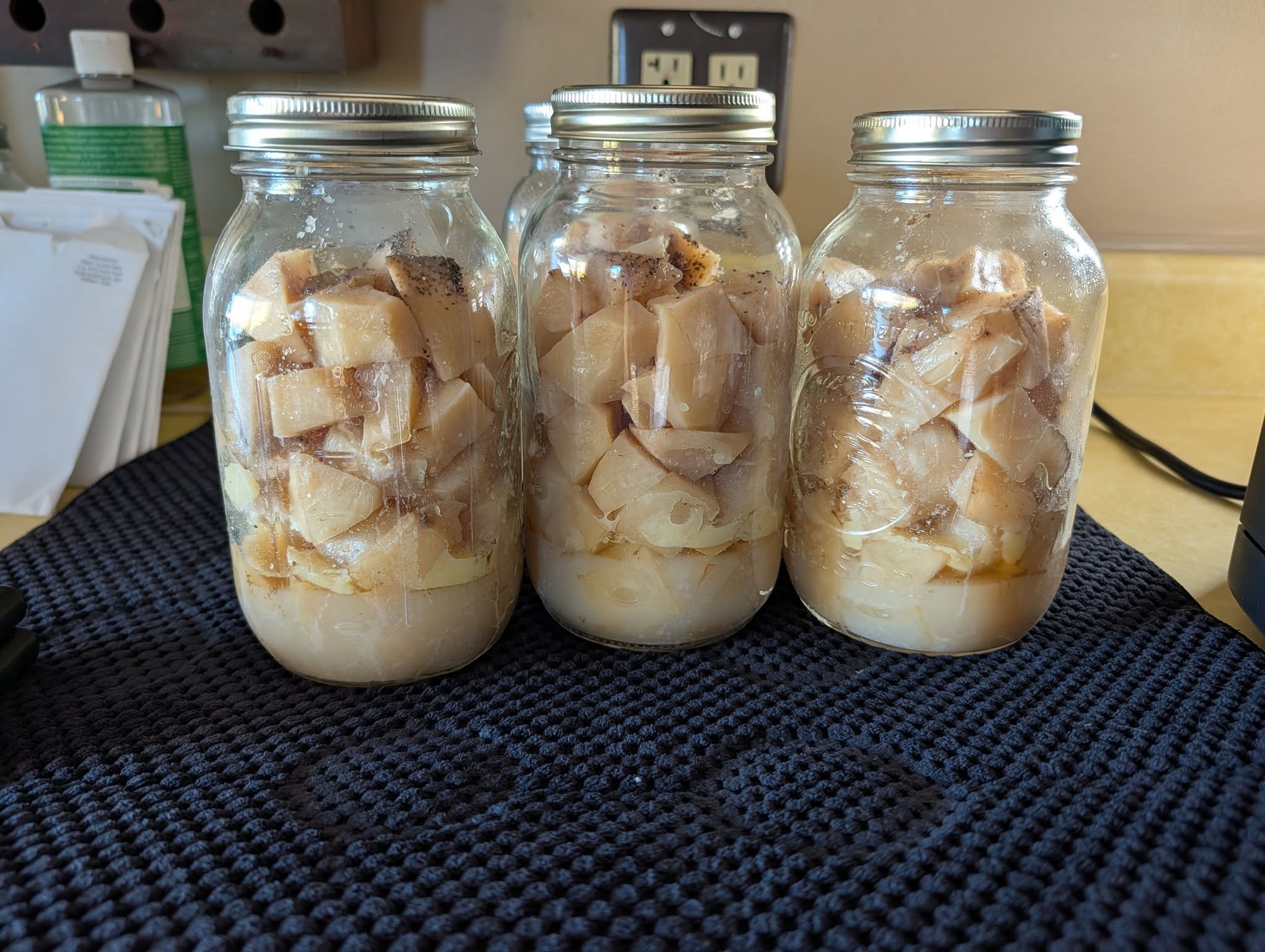
Pack: Ladle or spoon the hot, drained potatoes directly into the hot jars. Pack them snugly without crushing them.
-
Headspace: Leave exactly 1 inch of headspace at the top of each jar.
-
Liquid Note: In hot-pack potato canning, minimal liquid is added. The potatoes retain steam and natural moisture during pressure canning. If desired, you may add 1 to 2 tablespoons of boiling water per jar, but do not submerge them completely in liquid.
Step 5: Sealing and Loading
-
Remove trapped air bubbles by running a plastic bubble tool or spatula along the inside edge of each jar.
-
Adjust headspace to 1 inch if needed.
-
Wipe the rim of each jar with a clean, damp paper towel to remove starch or salt residue.
-
Place a lid on top and screw the metal band down until fingertip tight.
-
Lower the filled jars into the warm pressure canner using a jar lifter.
Pressure Canning Intensities & Processing Parameters
Adjust your processing pressure based on your elevation above sea level:
| Canner Type | 0 – 1,000 ft Elevation | 1,001 – 2,000 ft | 2,001 – 4,000 ft | 4,001 – 6,000 ft |
| Weighted Gauge | 10 lbs pressure | 15 lbs pressure | 15 lbs pressure | 15 lbs pressure |
| Dial Gauge | 11 lbs pressure | 12 lbs pressure | 13 lbs pressure | 14 lbs pressure |
Processing Times:
-
Pint Jars: 35 minutes
-
Quart Jars: 40 minutes
Heat Intensity & Venting Procedure:
-
Venting (High Intensity): Lock the canner lid. Turn stove heat to High. Allow steam to vent continuously from the petcock/vent pipe for 10 full minutes before applying the weight or pressure regulator.
-
Pressurizing: Place the weight on the vent pipe or close the petcock. Allow pressure to build until it reaches your target PSI (e.g., 10–11 lbs).
-
Processing (Medium Heat Adjustment): Once target pressure is reached, adjust stove heat to Medium or Low-Medium to maintain a steady, constant pressure for the entire processing time (35 min for pints, 40 min for quarts). Do not let pressure drop below your target.
Cool Down & Storage
-
After processing time ends, turn off heat completely. Allow the canner to cool and depressurize naturally. Do not force-cool the canner under cold water or remove the weight early.
-
Once pressure reads zero and 10 minutes have passed after removing the weight, carefully remove the canner lid away from your face.
-
Lift jars straight up with a jar lifter and place them on a towel-lined counter spaced 1 inch apart.
-
Allow jars to sit undisturbed for 12 to 24 hours. You will hear the satisfying “ping” as the vacuum seals set.
-
Check seals by pressing down on the center of each lid. Sealed lids will not flex up or down. Wash jars, label with contents and date, and store in a cool, dark place for up to 12–18 months.
Nutritional Information
(Serving Size: ½ cup cooked canned potatoes / approx. 100g)
| Nutrient | Amount Per Serving | % Daily Value |
| Calories | 77 kcal | — |
| Total Fat | 0.1 g | 0% |
| Saturated Fat | 0 g | 0% |
| Sodium | 150 mg (with added salt) | 6% |
| Total Carbohydrates | 17.5 g | 6% |
| Dietary Fiber | 1.8 g | 6% |
| Sugars | 0.8 g | — |
| Protein | 2.0 g | 4% |
| Potassium | 425 mg | 9% |
| Vitamin C | 19.7 mg | 22% |