
free hit counter javascript

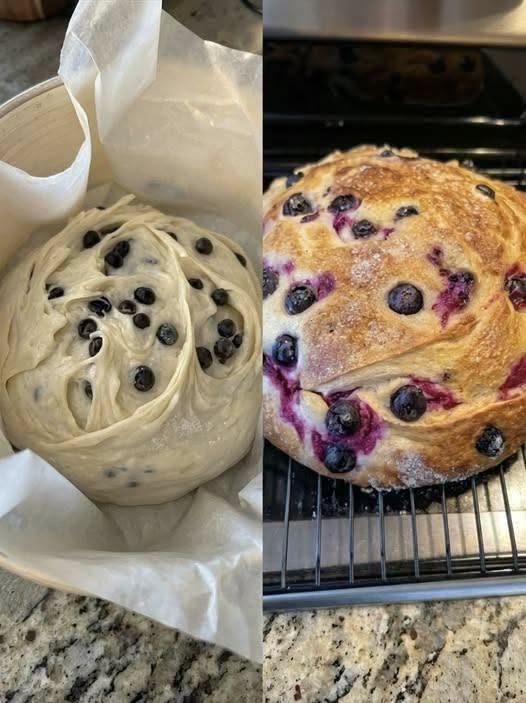
Blueberry Cream Cheese Sourdough Bread

Active Prep & Mixing 45 minutes High (Kneading, stretching, laminating)
Bulk Fermentation 4 to 6 hours Medium (Intermittent folding)
Cold Retard (Proofing) 12 to 24 hours Low (Completely inactive)
Baking 45 minutes Medium (Scoring and temperature management)
Cooling 2 to 3 hours Low (Mandatory resting)
Overall Difficulty Advanced Requires familiarity with sourdough hydration and inclusions

Ingredients

The Levain (Starter)

  • 35g Active, bubbly sourdough starter (100% hydration)

  • 35g Bread flour

  • 35g Whole wheat flour

  • 70g Water (Room temperature)

The Main Dough

  • 400g Bread flour (High protein, at least 12.5%)

  • 50g Whole wheat flour (For depth of flavor and fermentation vigor)

  • 320g Water (Ideally at 80°F / 27°C)

  • 10g Fine sea salt

  • 150g Mature levain (from above)

The Inclusions

  • 120g Fresh or frozen blueberries (If using frozen, do not thaw before folding. Toss lightly in 1 tbsp of flour to prevent excessive bleeding into the dough.)

  • 100g Full-fat block cream cheese, cut into ½-inch cubes (Place in the freezer for 20 minutes prior to laminating so it holds its shape during folding.)

  • 1 tbsp Granulated sugar or honey (Optional, to slightly sweeten the berries)

Method

1.Build the Levain:Plan 4-6 hours ahead of mixing.

In a tall jar, mix the active sourdough starter, bread flour, whole wheat flour, and water. Stir until no dry clumps remain. Cover loosely and leave at a warm room temperature (around 75°F/24°C). The levain is ready when it has doubled or tripled in volume, is highly aerated, and passes the float test (a small spoonful floats in a glass of water).

2.Autolyse:Hydrating the flour.

About 1 hour before your levain reaches its peak, mix the 400g of bread flour and 50g of whole wheat flour with 300g of the water (reserve the remaining 20g of water for mixing in the salt later). Mix just until a shaggy dough forms and no dry flour remains. Cover the bowl with a damp towel. This autolyse period allows the flour to fully absorb the water, kickstarting gluten development without the tightening effect of salt or the acidic degradation of the sourdough starter.

3.Incorporate Levain and Salt:Beginning the bulk fermentation.

Once the levain is peaking, dimple 150g of it into the autolysed dough. Pour the remaining 20g of water over the 10g of fine sea salt and add this to the bowl. Use your hands to pinch and fold the dough, thoroughly working the levain and salt into the matrix. Perform a series of “slap and folds” or aggressive kneading for about 5 to 7 minutes until the dough feels smooth, cohesive, and begins to pull away from the sides of the bowl. Check the dough temperature; ideally, it should be around 78°F (26°C). Cover and let rest for 30 minutes.

4.Develop Gluten (Stretch and Folds):Building strength.

Over the next 1.5 hours, perform three sets of stretch and folds spaced 30 minutes apart. To stretch and fold, wet your hands to prevent sticking. Reach under one side of the dough, pull it up until you feel resistance, and fold it over the center. Repeat this on all four sides of the dough (North, South, East, West). After the third set, the dough should feel remarkably stronger, elastic, and capable of holding its shape. Let it rest for another 30 minutes.

5.Lamination and Adding Inclusions:The most critical step for even distribution.

Mist a clean countertop lightly with water. Carefully turn the dough out onto the counter. With wet hands, gently stretch the dough outward from the center into a large, thin rectangle (laminating), being careful not to tear the gluten membrane.

Scatter the chilled cream cheese cubes and the flour-dusted blueberries evenly across the surface of the stretched dough. Fold the dough into thirds like a letter—bringing the left side to the middle, then the right side over that. Roll the dough up from the bottom to the top into a neat package. This method ensures the wet berries and soft cheese are trapped inside distinct layers rather than being crushed into a purple, soupy mess. Place the dough back in the bowl.

6.Finish Bulk Fermentation:Letting the dough rise.

Allow the dough to rest undisturbed for the remainder of the bulk fermentation (usually 2 to 3 more hours, depending on room temperature). You are looking for a 30% to 50% increase in volume, a domed top, smooth surface bubbles, and a jiggle when you shake the bowl. Because blueberries add extra moisture and acidity as they break down, do not push the bulk fermentation too far, or the dough will degrade and become impossible to shape.

7.Shaping:Building final tension.

Turn the dough out onto a lightly floured surface. Using a bench scraper, gently round the dough into a loose boule (ball). Let it rest for 20 minutes uncovered (this is the bench rest).

For the final shape, flip the dough over so the smooth side is down. Fold the edges into the center to create a tight package, then flip it back over. Use your hands to drag the dough towards you, using the friction of the counter to create surface tension. Be extremely gentle—if you pull too hard, the blueberries will burst through the surface, creating weak spots that will stick to your proofing basket. Dust the dough and a banneton (proofing basket) heavily with rice flour. Place the dough into the basket seam-side up.

8.Cold Retard:Developing flavor.

Cover the banneton with a plastic bag or a reusable shower cap to prevent the dough from drying out. Place it in the coldest part of your refrigerator for 12 to 24 hours. This cold retard slows down the yeast activity, allowing the lactic and acetic acids to develop complex sour flavors while firming up the dough for easier scoring.

9.Scoring and Baking:Managing steam and heat.

Place a Dutch oven (with the lid on) into your oven and preheat to 500°F (260°C) for a full 45 minutes.

Turn the cold dough out onto a piece of parchment paper. Using a baker’s lame or a very sharp razor blade, score the dough. Because of the inclusions, avoid intricate scoring patterns. A single deep, confident slash (at a 45-degree angle) works best to guide the expansion.

Carefully transfer the dough and parchment into the screaming-hot Dutch oven. Drop in two ice cubes between the parchment and the cast iron (not touching the dough) to create a burst of steam. Cover immediately and lower the oven temperature to 450°F (232°C). Bake covered for 25 minutes.

10.Crust Development and Cooling:Patience is mandatory.

After 25 minutes, carefully remove the lid. The bread should have experienced significant oven spring. Continue baking uncovered for another 15 to 20 minutes until the crust is a deep, mahogany brown. The internal temperature of the loaf should reach 208°F (97°C).

Remove the loaf and place it on a wire rack. Do not cut into the bread. Sourdough continues to cook and set its crumb as it cools. With heavy, wet inclusions like berries and cream cheese, cutting it while hot will result in a gummy, collapsed texture. Let it cool completely for a minimum of 2 to 3 hours before slicing.

Expert Baker’s Notes

  • Hydration Warning: Blueberries are little pockets of water. As they mix into the dough, they inevitably release some moisture. The base dough recipe uses an 80% hydration level (not counting the levain). If you live in a highly humid environment or are using a lower-protein flour, drop the initial water amount to 300g (75% hydration) to maintain a workable dough.

  • The “Blue Dough” Phenomenon: If you mix the blueberries directly into the dough during the initial slap-and-folds, the entire loaf will turn a murky grayish-blue, and the acid will rapidly break down the gluten. Laminating them in later preserves both the visual contrast of the white crumb and the structural integrity of the bread.

  • Storage: Because of the high moisture content of the berries and the dairy in the cream cheese, this bread spoils faster than a standard sourdough. Keep it in a paper bag at room temperature for the first 2 days. For longer storage, slice the entire loaf, separate the slices with parchment paper, and freeze them in an airtight bag. They toast perfectly straight from the freezer.

Nutritional Information

(Estimated per slice, assuming the loaf is cut into 12 equal slices)

Nutrient Amount
Calories 195 kcal
Total Fat 3.5 g
Saturated Fat 1.8 g
Cholesterol 8 mg
Sodium 360 mg
Total Carbohydrates 34 g
Dietary Fiber 2.5 g
Total Sugars 2.5 g
Protein 6.5 g

Related Posts

Leave a Reply

Your email address will not be published. Required fields are marked *