Prep Time: 45 minutes
Cook Time: 45–60 minutes (including water-bath processing)
Total Time: About 2 hours
Difficulty: Intermediate
Method: Water-bath canning
Intensity Level: Moderate — requires attention to timing, temperature, and safe canning practices
Why Make Your Own?
Home-canned diced tomatoes are one of the most rewarding pantry staples you can make. Unlike store-bought versions, you control the salt, the variety of tomato, and the texture. Firm, meaty tomatoes like Roma, San Marzano, or plum varieties work best because they hold their shape after dicing and canning. This recipe uses the water-bath method with added lemon juice or citric acid — an essential step for safe acidity levels when canning tomatoes.
Ingredients
-
3 kg (6½ lb) firm, ripe tomatoes (Roma or plum varieties recommended)
-
Bottled lemon juice — 1 tablespoon (15 ml) per pint jar, or 2 tablespoons (30 ml) per quart jar (or ¼ teaspoon citric acid per pint / ½ teaspoon per quart)
-
Canning salt (optional) — ½ teaspoon per pint, 1 teaspoon per quart
-
Water — for the canning pot and for blanching
Equipment needed:
-
Water-bath canner with rack (or a large stockpot with a rack)
-
6 pint jars or 3 quart jars, lids, and bands (sterilized)
-
Jar lifter, funnel, bubble remover, clean towels
-
Large pot for blanching, bowl of ice water
-
Sharp knife and cutting board
Step-by-Step Instructions
Phase 1: Preparation (15 minutes | Low intensity)
-
Sterilize the jars. Wash jars, lids, and bands in hot soapy water. Keep jars hot in the canner or a 90°C (195°F) oven until ready to fill. Simmer lids in hot (not boiling) water for 10 minutes.
-
Prepare the canner. Fill the water-bath canner halfway with water and bring it to a simmer (about 82°C / 180°F). You’ll bring it to a full rolling boil once jars are loaded.
-
Set up a work station. Place clean towels on the counter, and have your funnel, bubble remover, and jar lifter ready.
Phase 2: Peeling and Dicing (20–25 minutes | Moderate intensity)
-
Blanch the tomatoes. Bring a large pot of water to a boil. Working in batches, lower tomatoes into the boiling water for 30–60 seconds, until skins begin to split. Immediately transfer to the ice-water bath for 1–2 minutes to stop cooking. (Time: 30–60 sec boil; 1–2 min ice bath — intensity: moderate, keep the water at a steady rolling boil.)
-
Peel and core. Slip off the skins, remove the cores, and cut out any bruised spots.
-
Dice. Cut tomatoes into 1–1.5 cm (½-inch) cubes. Work over a bowl to catch juices. If tomatoes are very juicy, drain off some liquid — but keep a little to pack the jars.
Phase 3: Packing the Jars (10–15 minutes | Moderate intensity)
-
Add acid to each jar. Place 1 tbsp bottled lemon juice (or ¼ tsp citric acid) in each pint jar, or 2 tbsp (or ½ tsp citric acid) in each quart jar. Add optional canning salt.
-
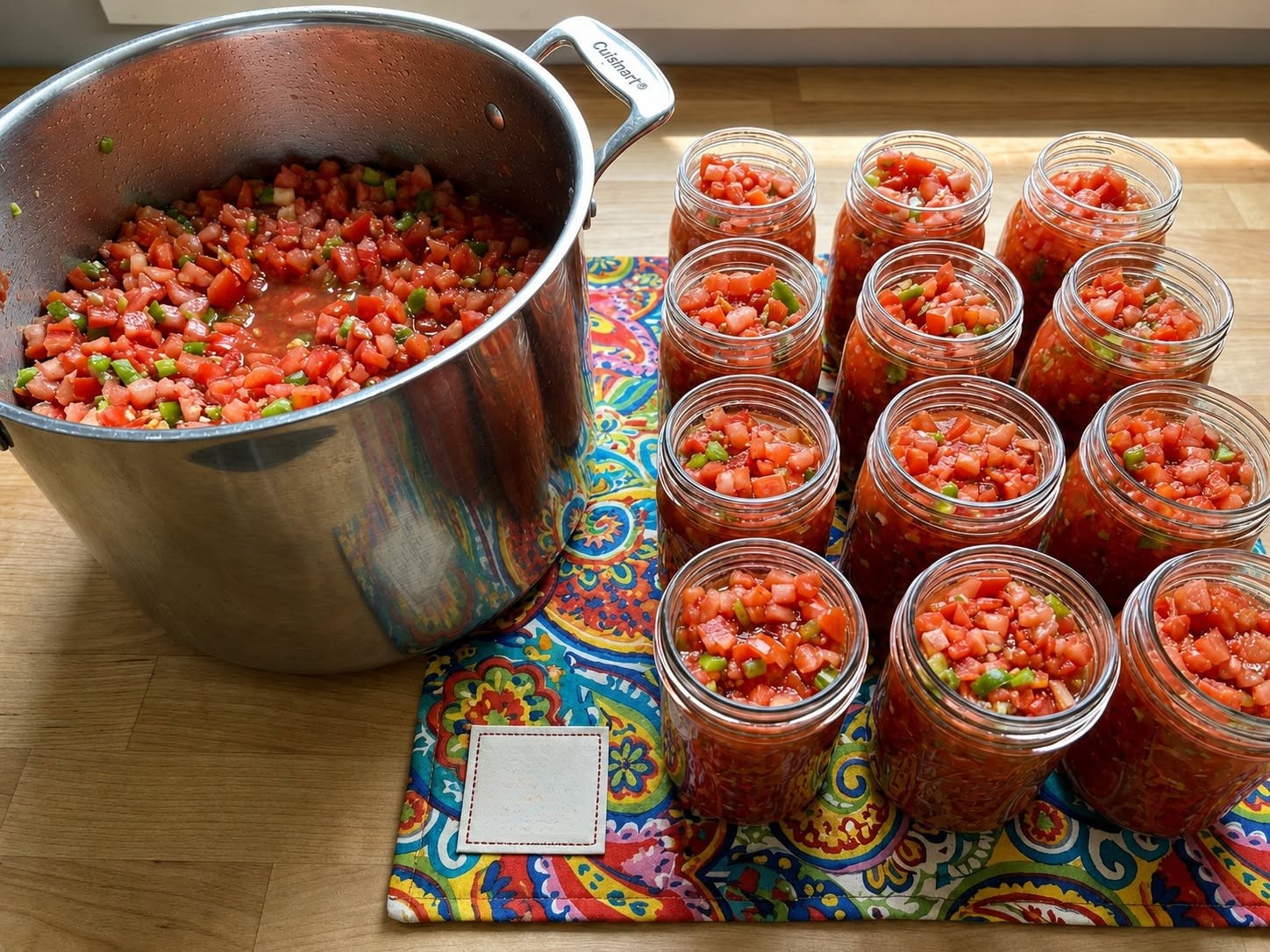
Pack the tomatoes. Using a funnel, fill jars with diced tomatoes and their juices, leaving 1.2 cm (½ inch) headspace. Press gently with a spoon to remove air pockets.
-
Remove bubbles. Run a bubble remover or plastic spatula around the inside of each jar. Add more tomatoes and juice to maintain ½-inch headspace.
-
Wipe rims and seal. Wipe jar rims with a damp cloth, center lids, and screw bands to fingertip-tight.
Phase 4: Water-Bath Processing (35–45 minutes | High intensity — constant monitoring)
-
Load the canner. Using a jar lifter, place jars on the rack in the simmering canner. Ensure jars are covered by at least 2.5 cm (1 inch) of water; add hot water if needed.
-
Bring to a rolling boil. Turn heat to high. Once a full rolling boil begins, start the timer:
-
Pints: process 35 minutes at a full rolling boil.
-
Quarts: process 45 minutes at a full rolling boil.
-
Altitude adjustment: Add 5 minutes for 300–1,500 m (1,000–5,000 ft); add 10 minutes above 1,500 m (5,000 ft). (Intensity: high — maintain a continuous boil; adjust heat as needed.)
-
-
Cool and check seals. Turn off heat, remove the canner lid, and wait 5 minutes. Lift jars out with the jar lifter and place on towels, spaced 2–3 cm apart. Do not tilt. Cool 12–24 hours undisturbed. Check seals: lids should be concave and not flex. Remove bands, label with date, and store in a cool, dark place.
Timing & Intensity Summary
| Phase | Time | Intensity |
|---|---|---|
| Preparation & sterilizing | 15 min | Low |
| Blanching & peeling | 20–25 min | Moderate |
| Dicing & packing jars | 10–15 min | Moderate |
| Water-bath processing | 35–45 min | High (constant monitoring) |
| Cooling & sealing | 12–24 hrs (passive) | Low |
Total active time: ~1½–2 hours
Notes, Tips & Variations
-
Do not skip the added acid. Tomatoes vary in acidity, and bottled lemon juice (not fresh) guarantees consistent pH for safe water-bath canning.
-
Firm varieties only. Overripe or juicy tomatoes turn mushy and are better used for sauce.
-
No thickeners or low-acid additions (onion, garlic, peppers, oil) in this basic recipe — they change the acidity and require pressure canning or tested recipes.
-
Variations: Add ½ tsp dried oregano or basil per jar for herbed tomatoes (dried herbs are safe in small amounts), or pack with ¼ tsp pickling spice for a subtly spiced version.
-
Storage: Best within 12–18 months. Discard any jar with a broken seal, off odor, or mold.
-
Yield note: 3 kg of tomatoes yields roughly 6 pints, depending on variety and juiciness.
Nutrition (per ½ cup / ~125 g serving, drained)
Estimates based on plain canned diced tomatoes without added salt.
-
Calories: 25 kcal
-
Protein: 1 g
-
Carbohydrates: 5 g
-
Dietary fiber: 1.5 g
-
Sugars: 3 g
-
Fat: 0.2 g
-
Sodium: 5–10 mg (without added salt; ~120 mg if salted)
-
Potassium: ~220 mg
-
Vitamin C: ~10% DV
-
Vitamin A: ~10% DV
-
Iron: ~2% DV