-
Prep Time: 30 Minutes
-
Cook Time: 20 Minutes
-
Process Time (Water Bath): 40 Minutes (Adjust for altitude)
-
Total Time: 1 Hour 30 Minutes
-
Yield: 4 Pint Jars (or 2 Quart Jars)
-
Intensity Level: Medium (Requires attention to boiling water and sterilization, but no complex knife work)
Ingredients
For the Brine:
-
3 cups White Vinegar (5% acidity)
-
3 cups Water
-
2 tablespoons Pickling Salt (Do not use iodized table salt)
-
1 tablespoon Sugar (optional, helps balance acidity)
For the Jars (Per Pint):
-
1.5 lbs Small, Firm Tomatoes (Roma, Cherry, or Pear tomatoes work best; avoid large slicers as they turn mushy)
-
1 clove Garlic, peeled
-
1 teaspoon Dill Seeds (or 1 fresh dill head)
-
½ teaspoon Black Peppercorns
-
¼ teaspoon Red Pepper Flakes (optional, for heat)
-
1 small Bay Leaf
Equipment Needed:
-
Water Bath Canner (or a large, deep stockpot with a lid)
-
4 Pint Jars or 2 Quart Jars (sterilized)
-
Jar Lifter and Lid Wand
-
Canning Lids and Rings
-
Large Saucepan (for brine)
-
Blanching Pot (for tomatoes)
Instructions
Phase 1: Preparation (Intensity: Low)
Time: 15 Minutes
-
Sterilize: Wash your jars, lids, and rings in hot, soapy water. Keep them hot until ready to use. If you are processing for shelf-stability, boil the jars for 10 minutes to sterilize.
-
Prepare the Tomatoes: Wash the tomatoes thoroughly. Remove any stems. Crucial Step: Using a paring knife, make a small “X” incision (about ½ inch deep) on the bottom of each tomato. This prevents the skin from splitting during the hot pack process.
-
Prepare the Brine: In a large saucepan, combine the vinegar, water, pickling salt, and sugar. Bring the mixture to a boil over High Heat (Intensity: High), stirring occasionally until the salt and sugar dissolve. Once boiling, reduce to a simmer to keep hot.
Phase 2: The Blanch & Pack (Intensity: Medium)
Time: 15 Minutes
-
Blanch: Fill a large pot with water and bring to a rolling boil. Working in batches, drop the tomatoes into the boiling water for 30 to 60 seconds. You will see the skin begin to peel back at the “X.” Do not overcook.
-
Ice Bath: Immediately transfer the tomatoes to a bowl of ice water. This stops the cooking process and makes them easy to handle. Once cool enough to touch, slip the skins off. Note: For pickled whole tomatoes, you can leave the skins on if they are thin, but removing them allows the brine to penetrate the flesh better. We recommend peeling for the best texture.
-
Pack the Jars: Place the garlic, dill, peppercorns, red pepper flakes, and bay leaf into the bottom of each hot jar.
-
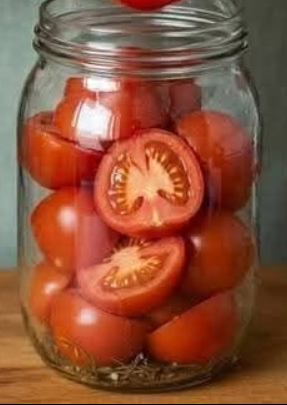
Fill: Gently pack the peeled whole tomatoes into the jars. Be firm but careful not to crush them. Pack them tightly, leaving ½ inch of headspace at the top of the jar.
-
Ladle Brine: Pour the hot brine over the tomatoes, ensuring they are completely covered. Maintain that ½ inch headspace.
-
De-bubble: Run a plastic knife or bubble popper around the inside of the jar to release trapped air bubbles. Wipe the rim with a clean, damp cloth, place the lid on, and screw the ring until “fingertip tight.”
Phase 3: Processing (Intensity: High)
Time: 45 Minutes
-
Water Bath: Place the jars in your water bath canner, ensuring they are covered by at least 1 inch of water. Bring the water to a rolling boil.
-
Process: Boil the jars for 40 minutes (for pints) or 45 minutes (for quarts). Important: If you live above 1,000 feet in elevation, add 5 minutes to the processing time for every 1,000 feet of altitude.
-
Cool Down: Turn off the heat and wait 5 minutes before removing the jars. Use a jar lifter to transfer them to a towel-lined counter. Let them cool undisturbed for 12 to 24 hours.
Phase 4: The Finish (Intensity: Low)
Time: 12-24 Hours
-
Check Seal: After 12 hours, press the center of each lid. If it does not pop back (it is concave), the jar is sealed. If it pops, store that jar in the fridge and eat within 2 weeks.
-
Storage: Remove the rings (to prevent rust), label, and store in a cool, dark place for up to 1 year.
Recipe Notes & Variations
-
The “Intensity” of Flavor: This recipe yields a classic, sharp pickle. If you prefer a sweeter tomato (like a bread-and-butter style), increase the sugar to ¼ cup and add 1 tablespoon of mustard seeds per jar.
-
Firmness: Use the firmest tomatoes you can find. Softer tomatoes will turn to mush. Cherry tomatoes are the most foolproof choice for maintaining a “pop” when bitten.
-
Safety First: Do not alter the ratio of vinegar to water. The acidity level (5% vinegar) is what makes these shelf-stable. If you reduce the vinegar, you must refrigerate the jars.
Nutritional Information
Disclaimer: The following nutrition information is an estimate per serving (1/2 cup or roughly 4-5 cherry tomatoes). The actual sodium content may vary depending on how much brine is absorbed and the specific salt used.
-
Calories: 45 kcal
-
Total Fat: 0.2 g
-
Sodium: 480 mg (This is a significant source of sodium due to the pickling salt; for a low-sodium version, use a salt substitute specifically designed for canning, though results may vary.)
-
Total Carbohydrates: 7 g
-
Dietary Fiber: 1.5 g
-
Total Sugars: 4 g (Includes 1g added sugar from brine)
-
Protein: 1 g
-
Vitamin C: 15% DV
-
Vitamin A: 10% DV
-
Calcium: 2% DV
-
Iron: 2% DV