-
Prep Time: 45 minutes
-
Passive Maceration Time: 2 hours (or up to overnight)
-
Cook Time: 20 minutes
-
Water Bath Processing Time: 15 minutes
-
Total Time: ~3 hours 20 minutes (plus cooling)
-
Yield: Approximately 5 Pint Jars (10 cups total / 80 servings at 2 tbsp each)
-
Difficulty & Heat Intensity: Low-intensity cooking (gentle simmering); Medium heat-intensity for canning processing.
Heat & Cook Intensity Profiles
Understanding thermal control is essential to maintaining the crisp texture of the vegetables while ensuring proper preservation:
-
Phase 1: Ambient Cold Salt Extraction (0 Intensity)
The vegetables rest at room temperature or in the refrigerator mixed with canning salt. No external heat is applied. This draws out excess moisture through osmosis, preventing a watery relish.
-
Phase 2: Brine Dissolution & Cook-Down (Medium-High to Medium Heat)
-
Boil Phase: High heat ($212^\circ\text{F} / 100^\circ\text{C}$) to dissolve sugars and infuse whole spices into vinegar.
-
Simmer Phase: Reduced to medium-low heat ($185^\circ\text{F} – 195^\circ\text{F}$) for 10–15 minutes. Gentle bubbles ensure the squash softens slightly without turning mushy.
-
-
Phase 3: Hot Water Bath Processing (High Continuous Heat)
-
Boil Phase: Full rolling boil ($212^\circ\text{F} / 100^\circ\text{C}$) under complete submersion for 15 minutes to sterilize jars and create a safe vacuum seal.
-
Equipment Needed
-
Food processor (or sharp chef’s knife)
-
5 pint-sized canning jars with new lids and rings
-
Boiling water bath canner with rack
-
Large stainless steel or non-reactive stockpot (Dutch oven)
-
Large colander & cheesecloth (or fine mesh strainer)
-
Jar lifter, canning funnel, and bubble remover tool
Ingredients
The Vegetable Base
-
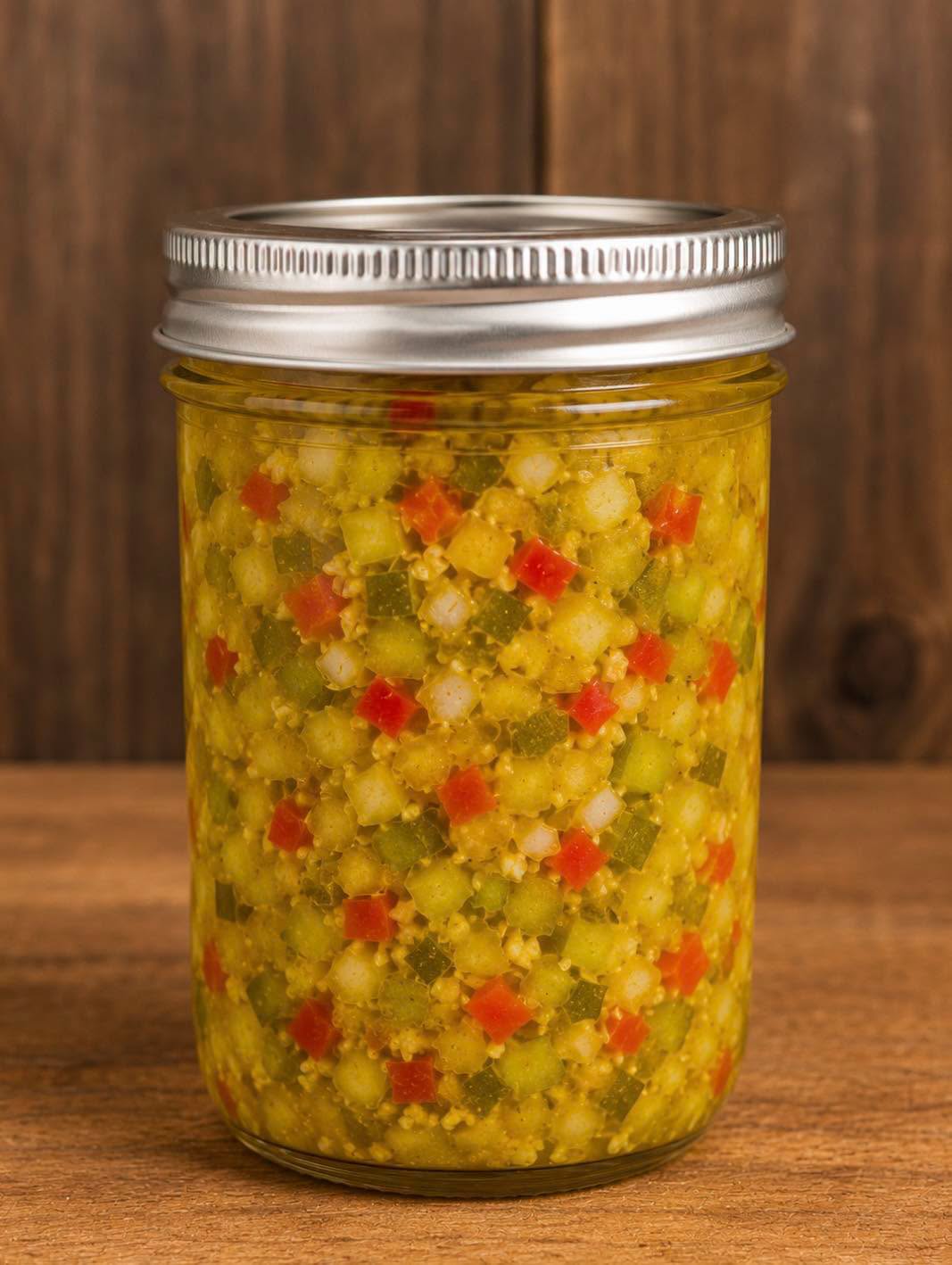
10 cups yellow summer squash (or a mixture of yellow squash and zucchini), finely diced or pulsed
-
3 cups sweet yellow or Vidalia onions, finely diced
-
2 cups red bell peppers, cored, seeded, and finely diced
-
1 cup green bell peppers, cored, seeded, and finely diced
-
$\frac{1}{4}$ cup non-iodized canning or pickling salt
The Sweet & Tangy Brine
-
3 cups granulated white sugar
-
2.5 cups apple cider vinegar (5% acidity)
-
$\frac{1}{2}$ cup water
-
2 tsp yellow mustard seeds
-
2 tsp celery seeds
-
1 tsp ground turmeric (for warm color and earthy depth)
-
1 tsp dry mustard powder
-
$\frac{1}{2}$ tsp coarsely ground black pepper
Step-by-Step Instructions
[ Step 1: Prep & Macerate ] ➔ [ Step 2: Rinse & Drain ] ➔ [ Step 3: Cook Brine & Simmer ] ➔ [ Step 4: Jar & Water Bath Process ]
Step 1: Prep & Macerate Vegetables
-
Wash all produce thoroughly under cold water. Trim stem and blossom ends off the squash.
-
Cut squash, onions, and bell peppers into medium chunks. Working in small batches, pulse in a food processor until evenly chopped into uniform, fine bits (avoid over-processing into a puree).
-
Transfer chopped vegetables into a large non-reactive glass or stainless steel bowl.
-
Sprinkle the $\frac{1}{4}$ cup of canning salt evenly over the vegetables and toss thoroughly.
-
Cover the bowl and let it sit at room temperature for 2 hours (or store in the refrigerator overnight).
Step 2: Rinse & Drain Excess Moisture
-
Transfer the salted vegetables into a colander or fine-mesh strainer.
-
Thoroughly rinse the vegetables under cold running water to remove excess surface salt.
-
Press firmly on the mixture with the back of a spoon, or wrap portions in clean cheesecloth and squeeze vigorously to remove as much liquid as possible. Set drained vegetables aside.
Step 3: Prepare the Brine & Simmer
-
In a large heavy-bottomed stockpot, combine the sugar, apple cider vinegar, water, mustard seeds, celery seeds, turmeric, dry mustard powder, and black pepper.
-
Set burner to high heat and bring the spice brine to a full, rolling boil, stirring until the sugar is fully dissolved.
-
Carefully stir in the drained vegetable mixture. Bring the entire pot back up to a boil.
-
Lower burner heat to medium-low and simmer uncovered for 10–12 minutes, stirring frequently to ensure heat distributes evenly.
Step 4: Jar Fill & Canning Process
-
Wash pint jars and lids in warm soapy water, keeping jars hot until filling.
-
Ladle hot relish into prepared pint jars using a canning funnel, leaving $\frac{1}{2}$-inch of headspace at the top.
-
Run a non-metallic spatula or bubble tool around the inside edge of each jar to release trapped air bubbles. Adjust headspace with extra brine if needed.
-
Wipe the jar rims clean with a moist paper towel dipped in warm water or vinegar. Place flat lids centered on the rims and screw ring bands on until fingertip tight.
-
Submerge jars into the water bath canner, ensuring at least 1 inch of boiling water covers the jar tops.
-
Cover pot and process at a continuous full boil for 15 minutes (adjust for altitude if above 1,000 feet).
-
Turn off heat, remove the canner lid, and let jars rest in the water for 5 minutes.
-
Use a jar lifter to transfer jars to a towel-lined counter. Allow them to cool undisturbed for 12 to 24 hours. Test lid seals after cooling; lids should not flex up or down when pressed in the center.
Nutritional Profile
Serving Size: 2 tablespoons (approx. 30g)
Servings Per Recipe: ~80 servings
| Nutrient | Amount Per Serving | % Daily Value (DV)* |
| Calories | 25 kcal | — |
| Total Fat | 0.1 g | 0% |
| Saturated Fat | 0.0 g | 0% |
| Trans Fat | 0.0 g | — |
| Cholesterol | 0 mg | 0% |
| Sodium | 145 mg | 6% |
| Total Carbohydrates | 6 g | 2% |
| Dietary Fiber | 0.4 g | 1% |
| Total Sugars | 5 g | — |
| Includes Added Sugars | 4.5 g | 9% |
| Protein | 0.3 g | 1% |
| Vitamin C | 4.2 mg | 5% |
| Calcium | 6.5 mg | 1% |
| Iron | 0.2 mg | 1% |
| Potassium | 45 mg | 1% |